Brass Bodhisattva Meditating Buddha Statue
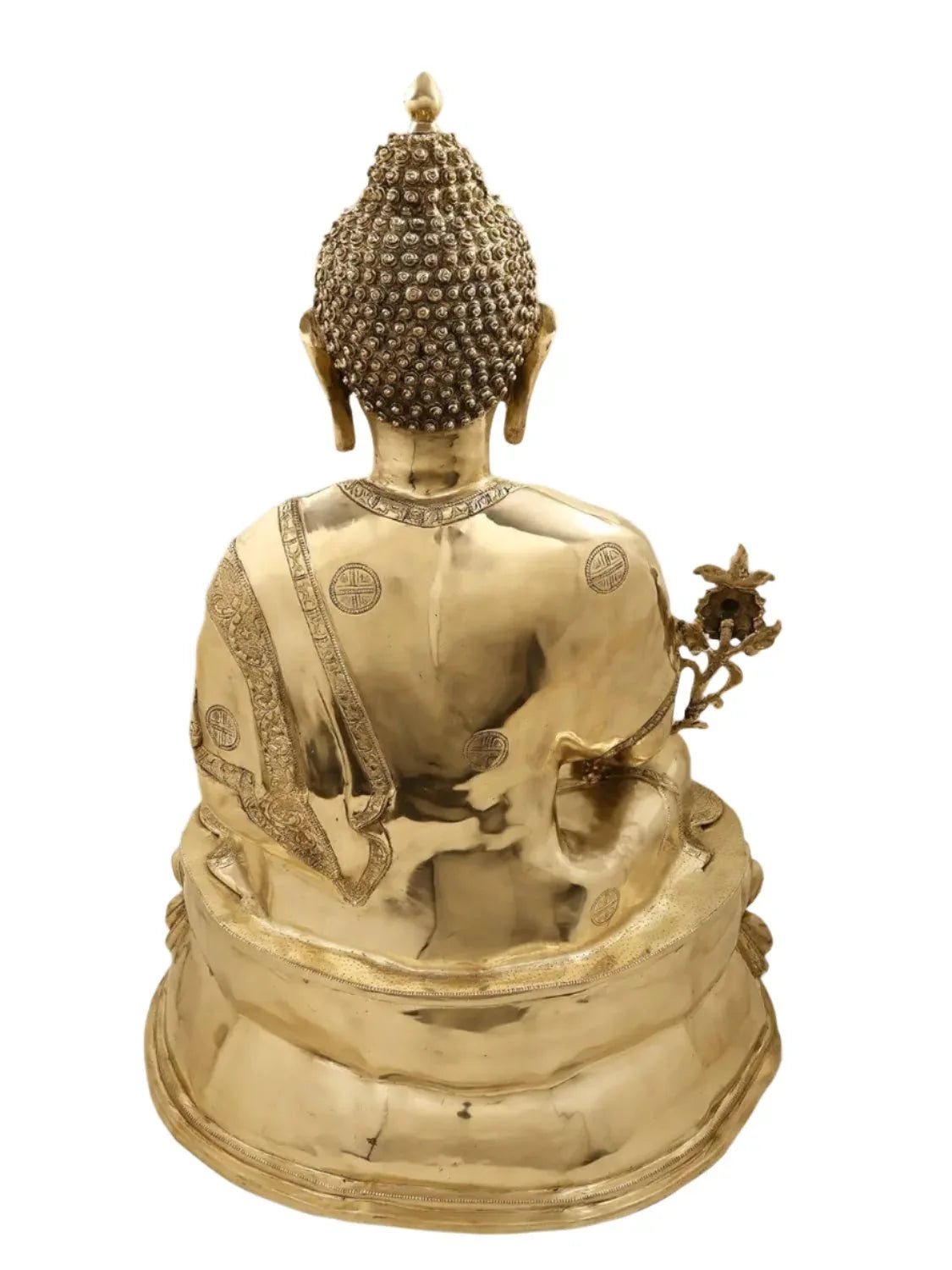
At 38 inches tall and 51 kilograms of solid brass, polished to a pure, luminous gold that appears lit from within, this Buddha does not merely occupy a space. He consecrates it. Seated in Padmasana with both hands resting in the perfect stillness of Dhyana Mudra, the meditation bowl cradled in his lap, his expression a masterwork of composed, selfless equanimity, this is the most complete and most quietly powerful Buddha composition we have ever created.
| Material |
Brass |
| Color |
Pale Gold |
| Size available |
38 inch Height x 25 inch Width x 16 inchs
|
| Item Weight |
51 Kg |
| Number of Items |
1 Brass Bodhisattva Meditating Buddha Murti
|
| Use |
Home, Pooja room, Temple, Office, Gifting
|
| Sold by |
Rachana Traders |
No stone inlay. No colour. Just the gold of purified brass and the perfection of the form. This is a piece for a meditation hall, a temple sanctuary, a healing centre, or a home with the space and the intention to receive it. It will be the first thing anyone sees when they enter the room. And the last thing they think of when they leave.
About This Monumental Brass Buddha Idol
To understand what makes this piece extraordinary, you need to start not with the scale, though the scale is extraordinary, but with the decision not to add stone inlay, not to add colour, not to add anything except the quality of the brass and the quality of the form.
In the great Buddhist bronze casting traditions of Nepal, Tibet, and the Pala kingdom of ancient Bengal, the highest expression of the seated meditation Buddha was always understood to be the single-tone gold finish, the luminous, unmodified surface of polished brass or gilt bronze that reflects light with the quality of pure, undifferentiated awareness. Stone inlay adds beauty. Colour adds narrative. But pure polished gold adds something that cannot be achieved by addition, a quality of presence that comes only from reduction, from the removal of everything that is not essential, until what remains is the form itself and the light that lives in it.
This Buddha achieves that. The face, slightly downcast eyes, the faintest curve of the lips in the half-smile of complete equanimity, the elongated earlobes of the prince who once wore heavy jewels, the Urna between the brows, the Ushnisha rising above, is a face that has been seen in the greatest Buddhist sculptures of every Asian tradition, reproduced and reinterpreted for two and a half millennia, and remains as moving now as it was when it was first conceived. The body, broad-shouldered, substantial, seated in the absolutely stable Padmasana that communicates immovability, rootedness, the decision not to move from this spot until understanding is complete, is the body of someone who has arrived.
The double lotus base, two tiers of large, fully-opened lotus petals, each petal individually modelled with the naturalistic curve and shadow line of a real flower, raises the figure with the dignity it deserves and grounds the entire composition with the stability of the lotus's symbolic meaning: the enlightened mind that has grown through the conditions of the world and bloomed above them, untouched and radiant.
At 38 inches and 51 kilograms, this is a piece that will define whatever space it inhabits for as long as it stands there. It is not a decoration. It is not an accent. It is a permanent sacred installation, the kind of object that people build rooms around, that organisations commission to mark the seriousness of their dedication to their purpose, that individuals acquire when they are ready to make a lasting commitment to the quality of presence they want in their most important space.
The Dhyana Mudra , The Gesture of Perfect Meditation
The Dhyana Mudra, both hands resting in the lap, right hand placed on the left, thumbs touching to form an oval, is the most fundamental and most complete gesture in the entire repertoire of Buddhist sacred sculpture.
It is the gesture of meditation itself. Not the beginning of meditation, not the aspiration toward meditation, but the full accomplishment of it, the state of complete, undistracted, effortless, undisturbed awareness that the entire Buddhist path leads toward and that this Buddha embodies in every cell of his 51-kilogram brass body.
The oval formed by the touching thumbs is a yantra, a sacred geometric form, representing the cosmic egg, the totality of awareness held in perfect balance. The right hand on top represents wisdom. The left hand below represents method, the compassionate action that wisdom generates in the world. Together they represent the complete union of wisdom and compassion that is the defining quality of the enlightened mind.
In the lap, cradled between the crossed legs in the bowl of the dhoti, the meditation bowl rests in the Dhyana Mudra hands, a detail that identifies this specific composition as the meditation form of Shakyamuni Buddha or of the universal Buddha nature. The bowl represents the vessel of the mind, empty, receptive, open, able to hold everything without being disturbed by anything.
This is the gesture and the expression of a mind that has arrived. Completely. Without remainder.
Why Pure Gold Brass , The Significance of the Single-Tone Finish
Many of our Buddha idols incorporate stone inlay, turquoise, coral, lapis , creating the vivid polychrome surfaces of the Tibetan sacred art tradition. This idol takes the opposite approach, and the reasons are as much theological as aesthetic.
In Buddhist iconographic tradition, the unmodified golden surface of polished brass or gilt bronze represents the fundamental luminosity of awareness itself, what the Tibetan tradition calls rigpa, the naked, unmodified, self-luminous quality of the mind's own nature. Gold in Buddhist sacred art is not wealth or ornament. It is the colour of awakened awareness, the quality of consciousness that, when all obscurations are removed, shines with the warmth and brilliance of the sun.
A Buddha figure in pure, unmodified gold brass is a Buddha figure that is, from crown to base, a single unified statement: this is what enlightened awareness looks like. Undivided. Undistracted. Completely itself.
The quality of the polish on this piece, the luminous, even, warm gold that catches light from every angle and appears to generate its own illumination, has been achieved through careful, time-intensive hand-polishing of the brass surface after casting and finishing. It is not a coating, not a plating, not a surface treatment that will wear away. It is the natural surface of high-quality brass brought to its maximum natural luminosity.
Over time, with exposure to incense smoke, the warmth of lamp flames, and the natural oxidation of the atmosphere, this surface will develop a deeper, more complex patina, the quality that collectors and monks both recognise as the sign of a sacred object that has been used, that has been prayed before, that has accumulated the invisible presence of devotion over years and decades. This deepening is not deterioration. In the Buddhist understanding, it is the mark of the object becoming more fully what it was always intended to be.
The Double Lotus Base , Sacred Architecture in Miniature
The base of this Buddha is a double lotus pedestal, and at this scale, with this level of detail, it is itself a significant sculptural achievement.
The lower tier is a wide, shallow disc of large outward-facing lotus petals, each petal fully rounded, individually modelled, with the naturalistic curve and the shadow line at the base that distinguishes a master-carved petal from a mechanically produced one. The upper tier is a second set of upward-facing petals that rise to cup the figure's seated form, the lotus in full bloom around the body of the meditating Buddha.
Between the two tiers, a band of bead-and-pearl detailing marks the boundary, a classical element of South Asian Buddhist sculpture base design that appears in the Gupta period bronzes of the 4th to 6th century CE and continues through the Pala tradition and into the Tibetan and Nepalese bronze schools.
The lotus base in Buddhist iconography is not a decorative convention. The lotus, which grows from muddy water and blooms above the surface clean and radiant, is the primary symbol of the enlightened mind's relationship to the world it arises from. The Buddha seated on the lotus is the mind that has bloomed from the conditions of existence into perfect clarity, present in the world, unstained by it, available to all who approach.
At 38 inches, the double lotus base is large enough for its individual petals to be clearly visible and appreciable from across a room. The scale of the base matches the scale of the figure, they are a unified composition, each element proportioned to the other with the precision of a sculptor who understood what they were making and why.
Craftsmanship & Product Details
What goes into every piece:
Material: Solid brass throughout, cast at monumental scale, hand-finished and hand-polished to pure gold luminosity. No stone inlay, no colour application, no coating.
Pose: Padmasana, full lotus seated meditation posture. Complete, stable, immovable.
Mudra: Dhyana Mudra, both hands in lap, right on left, thumbs touching, meditation bowl cradled in the oval of the hands.
Face: Classical Tibetan-influenced Buddhist facial proportions, slightly downcast eyes, half-smile, Urna between brows, elongated earlobes, Ushnisha with spiral curls.
Robe: Draped monastic robe, right shoulder bare in the North Indian Buddhist tradition, left shoulder covered. Robe border engraved with classical scroll and bead detailing at the edges.
Base: Double lotus pedestal, two tiers of fully modelled lotus petals, bead-and-pearl border between tiers, wide and stable at the base.
Finish: Pure polished gold brass, hand-polished to maximum natural luminosity. No coating, no plating. Will develop a natural patina with time that deepens the beauty of the piece.
Weight: 51 kg, solid brass throughout, no hollow sections.
Grade: Temple / Meditation Hall / Institutional / Heritage Collector.
Who This Idol Is Made For
A piece of this scale, weight, and intentionality is acquired with complete clarity of purpose. Here is who this Buddha is made for:
Dedicated meditation halls and retreat centres: A 38-inch pure gold brass Buddha in Dhyana Mudra is the defining altar piece of a serious meditation hall. His presence at the front of the space transforms the quality of every session held in that room, the effect is immediate and cumulative, growing more powerful over time as the space absorbs the quality of practice that happens before him.
Buddhist temples and institutional sanctuaries: A primary altar piece for a Theravada, Mahayana, or Vajrayana Buddhist temple or shrine room, of the scale and quality that the dharma deserves.
Yoga studios and wellness centres: For any space dedicated to the cultivation of inner stillness, this Buddha is the most powerful single sacred object you can install. His presence establishes the intention of the space beyond any need for words.
Healing centres and integrative practices: For spaces where the healing of mind and body is the explicit purpose, a 38-inch meditation Buddha sets the atmosphere of the entire facility from the moment a client enters.
Heritage collectors of Buddhist sacred bronze: A 38-inch, 51 kg solid brass Dhyana Mudra Buddha in pure gold finish, of this quality of casting and finish, is a museum-calibre piece of Buddhist sacred metalwork, one that will appreciate in significance over generations.
Frequently Asked Questions
Is this idol completely solid brass? Yes , solid brass throughout, from the base of the double lotus pedestal to the top of the Ushnisha. No hollow sections, no resin fill, no internal armature. The 51 kg weight at 38 inches is the measure of that.
Is the gold finish a coating or natural brass? It is the natural surface of high-quality brass, hand-polished to its maximum natural luminosity. There is no gold coating, no gold plating, and no surface treatment that will wear away. The finish is the brass itself.
Will the gold colour change over time? Yes , naturally and beautifully. Brass develops a patina over time through exposure to air, incense smoke, lamp heat, and the environment of regular devotional use. The colour deepens and mellows gradually, taking on the warm, complex tone of aged brass that is characteristic of the great monastery bronzes of Asia. This is considered a desirable quality, not a defect.
Is this suitable for Buddhist practice of any tradition? Yes , the Dhyana Mudra seated Buddha in pure gold brass is a universal form, recognised and appropriate across Theravada, Mahayana, and Vajrayana Buddhist traditions, and in Hindu households where Buddha is revered as an avatar of Vishnu.
How many people are needed for installation? A minimum of three people for safe unpacking and placement of a 51 kg piece. We recommend four people for the final positioning, particularly if the installation surface is elevated or requires manoeuvring in a confined space.
Is institutional or collector pricing available? Yes , for temples, meditation centres, wellness institutions, and serious collectors, contact our team directly for dedicated pricing, logistics support, customs guidance, and where available, installation coordination.


 Sold out
 Sold out


