Brass Ganesha Lakshmi Saraswati Temple Golden Finish Statue
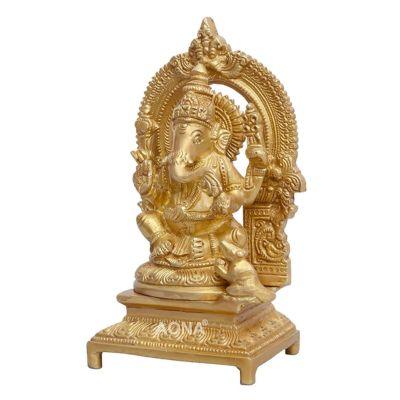
This 7-inch brass trio, Goddess Lakshmi, Lord Ganesha, and Goddess Saraswati, is made in the classical South Indian temple idol tradition. Each deity sits on its own individually engraved footed base. Each is framed by their own full prabhavali arch, the decorative halo arch of temple murti iconography, carved with the density and precision of the finest South Indian temple metalwork.
| Material |
Brass |
| Color |
Gold |
| Size available |
Height 7 inch x Width 4 inch x Depth 3 inch ( Each idol ) |
| Item Weight |
4 Kg |
| Number of Items |
1 Ganesh Lakshmi and Saraswati Brass Idol |
| Suitable for |
Home, Office, Gifting, Temple |
| Sold by |
Rachana Traders |
. And all three are finished in the warm, luminous antique gold that is the hallmark of Thanjavur and Swamimalai brass craft at its best. At 4.4 kilograms for the complete set, with the heft and presence of genuine solid brass and the visual authority of a temple installation, this is the most complete and most devotionally serious version of this trio composition we have ever offered.
About This Temple-Style Trio Idol Set
The combination of Lakshmi, Ganesha, and Saraswati, the three deities who together provide the complete range of blessings a Hindu household traditionally prays for, has been one of the most beloved sacred arrangements in India for centuries. But the form in which they are presented matters enormously, and this trio set presents them in the most authoritative form available in domestic sacred art: the South Indian temple idol style, with prabhavali arch and engraved footed base.
In the great temples of Tamil Nadu and Karnataka, the Brihadeeswarar at Thanjavur, the Chennakeshava at Belur, the Virupaksha at Hampi, the primary deities are always presented within a prabhavali, the sacred halo arch that frames the deity with the visual grammar of divine presence and royal authority. The prabhavali, from the Sanskrit prabha (radiance) and vali (series or row), is literally a series of radiating divine light, rendered in architectural form. Its presence transforms a figure from a sacred object into a temple murti, a deity in permanent, consecrated residence.
Each idol in this set has its own individual prabhavali arch, fully detailed, richly carved, with the density of surface work that defines the South Indian temple tradition. And each sits on its own individual engraved footed base, a low, wide plinth with surface engraving and small feet at the four corners, exactly replicating the form of the pitha on which temple murtis are installed.
The result is three complete, self-contained temple compositions, each idol in its own sacred architectural frame, capable of standing independently or arranged as a unified trio. This is what temple worship looks like, brought home.
Each Deity in Their Temple Form
Goddess Lakshmi, Left: Seated in Padmasana, four-armed, Goddess Lakshmi is depicted in the full richness of the South Indian temple tradition. Her prabhavali arch, carved with lotus and scroll motifs, its outer border alive with decorative detailing, frames her with the warmth of divine abundance. Lotus blooms in her upper hands. Varada Mudra in her lower right, the gesture of unconditional generosity, the open palm that says ask and it shall be given. Her crown, jewellery, and garments are individually detailed with the precision of temple sculpture. The expression on her face is the expression Lakshmi always wears in the finest South Indian sacred art, completely, unhurriedly generous, as if giving is simply what she is made of.
Lord Ganesha, Centre: Seated at the centre, as tradition requires, on his individual lotus base within his own prabhavali arch, Ganesha is depicted in the royal Maharaja pose of the South Indian temple tradition. His arch is the most elaborate of the three, the central position demands it, with the densest surface carving and the most complete decorative programme. Four arms bearing his characteristic attributes. Mouse Mooshika at the base of the lotus. His expression, wide-eyed, completely composed, entirely benevolent, is the expression that has been carved into the doorways of South Indian temples for fifteen centuries: the face that every devotee passes beneath when entering the sacred space, receiving his blessing simply by walking through.
Goddess Saraswati, Right: Seated with her Veena in playing position within her own prabhavali arch, Goddess Saraswati is depicted with the particular quality of focused, creative intelligence that the South Indian temple tradition has always expressed so perfectly. Her arch matches Lakshmi's in scale and detail, creating visual balance across the trio. Four arms, Veena, scriptures, rosary, and the gesture of the teacher pointing toward truth. Her crown is as elaborate as her companions'. Her expression is the expression of someone whose inner world is genuinely more interesting than everything happening outside it, the focused tranquility of a mind in complete command of its knowledge.
The Prabhavali Arches: Each arch is a full decorative programme in itself, not simply a frame but a composition. The inner border carries the closest-set decorative detailing: a series of petals or scrollwork elements radiating outward from the deity's head. The outer border carries a secondary decorative band. The apex of each arch carries a crown finial, a lotus or Kirtimukha element that marks the highest point of the sacred space. The sides of each arch connect to the base with carved pillar-like elements that complete the architectural frame.
The Engraved Footed Bases: Each base is a low, wide rectangular plinth with surface engraving across the top and front faces, floral and scroll motifs in the South Indian temple furniture tradition. Four small feet raise each base slightly from the display surface, giving the entire composition the slight elevation that distinguishes a properly installed temple idol from one simply placed on a shelf.
The South Indian Temple Brass Tradition
The craft tradition from which these idols emerge, the Panchaloha and brass idol-making of Tamil Nadu and Karnataka, centered in towns like Swamimalai, Kumbakonam, and Thanjavur, is one of the oldest and most technically demanding sacred metalwork traditions in the world.
The shilpis (craftsmen) of this tradition work within the framework of the Agama Shastra, the ancient Sanskrit texts that specify the precise proportions, attributes, poses, and finishing standards for every deity in every form. An idol made within this tradition is not the craftsman's personal interpretation of a deity. It is a precisely specified sacred form, every measurement, every attribute, every detail governed by rules developed over millennia of temple practice.
What distinguishes the finest work in this tradition, and what distinguishes this set, is the surface density of the prabhavali arch and base. The Agama specifies not just what should be present but how much. The finest temple murtis are the ones where no surface has been left without its appropriate decorative programme, where the visual message is one of sacred fullness, of completeness, of a world in which every surface is an opportunity for beauty and meaning.
This set achieves that standard, and in doing so, it brings the visual language of the great South Indian temple tradition into a domestic, everyday, accessible form.
Craftsmanship & Product Details
What goes into every piece:
- Material: Solid brass throughout, all three idols, prabhavali arches, and engraved footed bases cast in brass and hand-finished.
- Style: Classical South Indian temple idol tradition, Agama Shastra-informed proportions and attribute arrangement.
- Each Idol: Individual prabhavali arch, fully carved with lotus, scroll, and decorative border motifs. Individual engraved footed base, scroll and floral surface engraving, four corner feet.
- Lakshmi: Padmasana, four arms, lotus blooms, Varada Mudra, elaborate crown and jewellery.
- Ganesha: Maharaja seated pose, four arms, Mooshika at base, most elaborate prabhavali arch of the three.
- Saraswati: Seated with Veena in playing position, four arms, scriptures, rosary, matching crown and jewellery.
- Finish: Warm antique gold brass, hand-polished to a consistent luminous finish across all three idols, arches, and bases.
- Total Set Weight: 4.4 kg across all three complete idols.
- Each Idol Dimensions: Height 7 inches, Width 4 inches, Depth 3 inches.
- Suitable For: Pooja room, home mandir, living room, Diwali worship, Saraswati Puja, gifting as a complete set or individually.
How to Arrange This Set
The most traditional and visually complete arrangement is as a temple trio, Ganesha at the centre, Lakshmi to his right (your left as you face them), Saraswati to his left (your right). The three arches should be close enough that they appear to form a continuous sacred screen, the visual effect of a temple's main sanctum, with three deities in their individual shrines visible simultaneously.
For those who know the South Indian temple tradition specifically: Ganesha always precedes. He occupies the centre position because nothing, no worship, no auspicious beginning, no sacred installation, happens without his blessing first.
Alternative arrangements that work equally well with individual bases:
Ascending triangle: Ganesha slightly forward of the other two, Lakshmi and Saraswati flanking at a slight angle behind, creating a three-dimensional composition rather than a flat line.
Separated rooms: Ganesha at the pooja room entrance, Lakshmi at the primary worship position, Saraswati in the study, each deity's specific blessing placed where it is most needed.
Festival rotation: During Saraswati Puja, Saraswati moves to the centre. During Diwali, the standard arrangement with Ganesha at centre. The individual bases make this rotation possible and natural.
Vastu Shastra recommends placing this trio on the north-east shelf of the pooja room, facing east, at eye level when seated in prayer.
The Perfect Gift for Every Occasion
- Diwali: This set is the most complete and most beautifully made Diwali gift in our collection. The temple-style prabhavali arches give it a visual authority that distinguishes it from every other Lakshmi-Ganesha-Saraswati set on the market. For a recipient who appreciates quality and knows what they are looking at, this is the gift.
- Housewarming: Three complete temple compositions for a new home, Ganesha's obstacle-removing blessing, Lakshmi's abundance, and Saraswati's wisdom, each in their own sacred architectural frame, from the very first day. The most complete housewarming blessing possible in a single gift.
- Saraswati Puja and Vasant Panchami: The temple-style Saraswati idol in this set, with her full prabhavali arch and engraved base, is a significantly more serious and beautiful piece than the generic Saraswati idols typically available for this occasion. A gift that honours the goddess at the level she deserves.
- Wedding Gift: For a couple setting up their first home together, three temple-quality idols that will anchor their pooja room for decades and define the sacred atmosphere of their household from the beginning.
- Graduation: For a student completing their studies, the blessing of all three deities at the moment of transition is the most complete and most meaningful gift possible.
- Corporate Inauguration: Three deities, wisdom, abundance, and the removal of obstacles, in temple-quality form, for the opening of a new business, office, or institution. The most auspicious and most visually impressive corporate inauguration gift in our collection.
Frequently Asked Questions
- Are the three idols sold as a complete set only? They are offered as a complete set of three. If you are interested in purchasing individual idols from this set separately, please contact our team and we will advise on availability.
- Is the prabhavali arch attached to the base or separate? On each idol, the prabhavali arch and the engraved footed base are cast as a unified composition with the deity figure, not separately attached. Each idol is a single, complete, self-contained piece.
- Are all three idols the same height? Yes, each idol is 7 inches in height including the arch, with consistent proportions and finish across the set. Ganesha's prabhavali arch is slightly more elaborate in surface detailing, consistent with his central position in the trio.
- Is this set suitable for daily pooja, including abhishek? Yes, solid brass is the most traditional and most auspicious material for daily pooja. For abhishek, dry each idol gently and thoroughly afterward, paying attention to the carved recesses of the arch and base where moisture can accumulate.
- Does it come gift-ready? Yes, all three idols ship together in a premium gift box with individual foam cushioning for each piece, protecting the arch detailing and engraved base surfaces during transit. The set arrives completely ready to present as a gift.


 Sold out
 Sold out


