Brass Tibetan Buddhist Deity Set of 5 — 5.5 Inch Handcrafted Green Tara, White Tara, Manjushri, Chenrezig & Vajradhara | Black Gold Two-Tone
Five of the most beloved and most widely practised deities in the Tibetan Vajrayana Buddhist tradition. Five complete sacred presences. One set.
| Material |
Brass |
| Color |
Golden Black |
| Size available |
Height : 5.5" X Width: 4" X Depth : 2.5" Inch |
| Item Weight |
3.7 Kg |
| Number of Items |
5 Pcs of Brass Tibetan Bodhisattvas
|
| Suitable for |
Meditation altar, Buddhist practice space, yoga studio, living room |
| Sold by |
Rachana Traders |
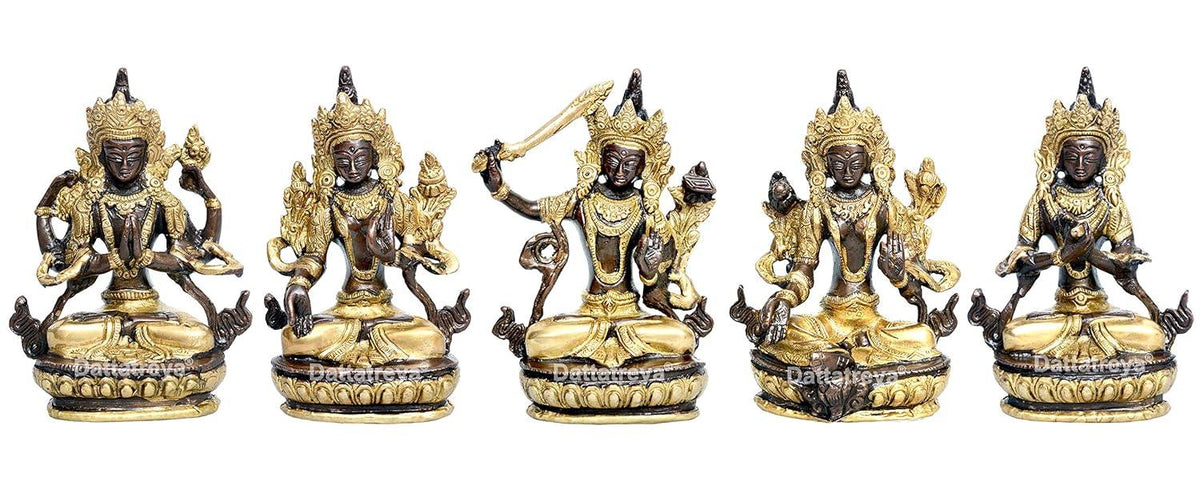
Each figure individually cast at 5.5 inches in solid brass with the black-and-gold two-tone finish that gives this set its specific visual character: the deep dark patination of the body, the warm polished gold of the face, crown, and lotus base, the visual language of darkness and light that the Tibetan bronze tradition has always used to communicate the relationship between the infinite ground of awareness and the luminous quality of enlightened consciousness that arises from it.
At 3.2 kilograms for the complete set of five, with each deity fully identifiable by their specific attributes and mudras, this is the most complete and most visually cohesive Tibetan Buddhist altar arrangement available at this scale.
The Five Deities, Who They Are
Chenrezig (Avalokiteshvara), Far Left: The bodhisattva of compassion, the deity who vowed to remain until every sentient being is liberated from suffering. Depicted in his four-armed form with hands joined in Anjali Mudra at the heart, holding the lotus and crystal rosary in the outer arms. His mantra, Om Mani Padme Hum, is the most widely recited sacred formula in Tibetan Buddhism. He is the patron deity of Tibet and the embodiment of the compassion that is the heart of the Buddhist path.
Green Tara (Shyama Tara), Second from Left: The most beloved deity in the Tibetan Buddhist pantheon, the swift, active, immediately responsive aspect of compassionate awareness. Depicted seated with her left leg folded and right leg extended in the posture of readiness to rise and help. She holds the utpala lotus and extends Varada Mudra, the gesture of giving. Green Tara is invoked for protection from the eight fears, for swift assistance in difficulty, and as the mother who responds immediately to sincere prayer.
Manjushri, Centre: The bodhisattva of wisdom, the deity whose flaming sword of prajna cuts through the root of ignorance with the precision of the highest understanding. Manjushri is depicted standing in this set with his sword raised above his head, the most dramatic and visually commanding of the five figures, the centre figure whose vertical energy anchors the entire arrangement. He holds the Prajnaparamita sutra in his lower hand, the perfection of wisdom text, the knowledge that makes the sword's cutting possible. He is the patron of students, scholars, and all who work with the life of the mind.
White Tara (Sita Tara), Second from Right: The contemplative, sustained aspect of compassion, where Green Tara is swift response, White Tara is the deep, enduring quality of compassionate awareness that persists through time and difficulty. She is associated with longevity, healing, and the removal of illness-related obstacles. Her seven eyes, one in each palm and sole, and the third eye, represent the all-seeing awareness that perceives suffering wherever it exists. She holds the lotus of purity and extends both protection and blessing.
Vajradhara, Far Right: The primordial Buddha of the Vajrayana tradition, the dharmakaya from whom all tantric lineages originate. Not a historical Buddha but the ground state of awareness itself, from which all compassionate activity arises. He holds the vajra and bell crossed at his heart, the union of skilful means and wisdom, the fundamental dyad of tantric practice, the gesture that represents the complete union of the masculine and feminine principles of awakened experience.
The Black-Gold Two-Tone Finish
The dark patination and polished gold of this set's two-tone finish is the element that most immediately distinguishes it from the multicolour version of the set available elsewhere in our collection, and it represents a deliberate and considered aesthetic choice.
In the Tibetan Buddhist bronze tradition, the most sacred and most ancient ritual objects are typically single-tone or two-tone, the complexity of the surface coming from the quality of the modelling and the depth of the metal rather than from applied colour. The two-tone black-and-gold finish honours that tradition: the darkness of the body communicating the infinite ground of awareness, the gold of the face and lotus communicating the luminous, self-arising quality of enlightened consciousness.
For a meditation altar, the two-tone finish creates a contemplative visual atmosphere that multicolour finishes, however beautiful, cannot match, the darkness absorbs the attention inward, the gold catches the eye and the lamp light, and the five figures together create a field of alternating depth and radiance that supports the quality of awareness meditation practice cultivates.
Arranging the Five Figures as a Complete Altar
The traditional arrangement for a five-deity Tibetan Buddhist altar places the most primordial deity at the centre, Manjushri's standing form with the raised sword creates the natural vertical anchor of the composition, with the two pairs flanking symmetrically. Chenrezig and Vajradhara at the outer positions represent the twin pillars of the Buddhist path: compassionate activity (Chenrezig) and the primordial ground from which it arises (Vajradhara). The two Taras in the inner positions represent the active and contemplative expressions of the same compassionate impulse.
Together the five figures cover every dimension of the enlightened mind that daily practice engages: the ground awareness of Vajradhara, the sword-clarity of Manjushri, the swift responsive compassion of Green Tara, the sustained healing compassion of White Tara, and the universal compassion that reaches every being of Chenrezig.
How This Set Differs from the Set of Seven
We offer this same tradition of Tibetan Buddhist deity figures in a set of seven (with a multicoloured antique finish) and this set of five (in the black-and-gold two-tone finish). Here is how to choose:
The Set of Seven (Multicolour): More figures, more colour, more visual variety across the set. For a practice space that benefits from the full visual richness of the Tibetan festival tradition. For gifting occasions where abundance and completeness are the primary values.
This Set of Five (Black-Gold): Five core figures in the most contemplatively serious finish. For a meditation altar where the two-tone finish supports inward attention. For a practitioner who works specifically with these five deities. For a contemporary interior where the black-gold palette works more naturally than the multicoloured version.
The Perfect Gift For
Buddhist practitioners, the five core deities of the Vajrayana tradition in a single complete set, in the finish most appropriate for serious practice.
Meditation centres and yoga studios, a five-figure Tibetan altar for a shared practice space. Housewarming for Buddhist households, the complete practice altar as a single gift for a new sacred space.
Collectors of Tibetan Buddhist sacred metalwork, the black-gold two-tone finish at this quality level is the most historically resonant version of these figures available.
Frequently Asked Questions
Which five deities are included? Chenrezig (Avalokiteshvara), Green Tara, Manjushri, White Tara, and Vajradhara.
Are all five figures solid brass? Yes, each figure is individually cast in solid brass.
Is this suitable for daily Buddhist practice? Yes, solid brass is the traditional material for Buddhist altar objects.
How is Manjushri depicted, seated or standing? Standing, with his flaming sword raised above his head, the most visually dynamic of the five figures and the natural centre of the arrangement.
Does it come gift-ready? Yes, premium gift box with individual foam cushioning for all five figures.
Is international shipping available? Yes, 30+ countries. Contact us for rates.


 Sold out
 Sold out


